


How to make the masseter muscle smaller
Sep 10, 2024
Source: Cainiu Health

Dr. Han Xuefeng
Introduction
In general, enlarged masseter muscles may be related to factors such as improper bite alignment, genetics, broad mandible, or fat accumulation. In daily life, one can improve the appearance of large masseter muscles by avoiding excessive chewing of hard objects and by massaging to relax the muscles. If these methods are ineffective, medical aesthetic treatments such as injections of botulinum toxin type A, corrective surgery for masseter hypertrophy, jawbone contouring surgery, or liposuction may be considered.
In general, enlarged masseter muscles may be related to factors such as improper occlusion, genetics, wide mandible, or fat accumulation. In daily life, this condition can be improved by avoiding excessive chewing of hard objects and massaging the masseter muscles to promote relaxation. If these methods are ineffective, aesthetic medical procedures such as injection of botulinum toxin type A, masseter muscle reduction surgery, mandibular angle reduction (bone grinding), or liposuction may also be considered. Individuals seeking improvement are advised to consult a reputable medical institution.
If one frequently chews hard foods—such as betel nuts, chewing gum, or sugarcane—in daily life, the masseter muscles will contract forcefully and repeatedly, leading to thickening of muscle fibers and ultimately resulting in masseter muscle hypertrophy. Reducing the consumption of such foods can decrease the intensity of masseter muscle exercise. Additionally, circular massage along the contour of the masseter muscle can be performed upward, with mild soreness or swelling as the desired sensation. Each massage session should last 3–5 minutes and be done 2–3 times per day.
Analysis of surgical options for improving enlarged masseter muscles:
| Cause | Improper Occlusion | Genetics | Wide Mandible | Fat Accumulation |
| Cause Analysis | Due to improper occlusion, the masseter muscle must contract strongly to achieve proper biting, leading to muscle enlargement. | If family members have large masseter muscles, offspring are more likely to develop the same trait. | When the mandible is wide, the masseter muscle may enlarge compensatorily to maintain normal chewing function. | Facial fat accumulation gives the appearance of prominent masseter muscles. |
| Improvement Methods | Botulinum Toxin Type A Injection | Masseter Muscle Reduction Surgery |
Mandibular Angle Reduction Surgery | Liposuction |
| Reference Image |  |
 |
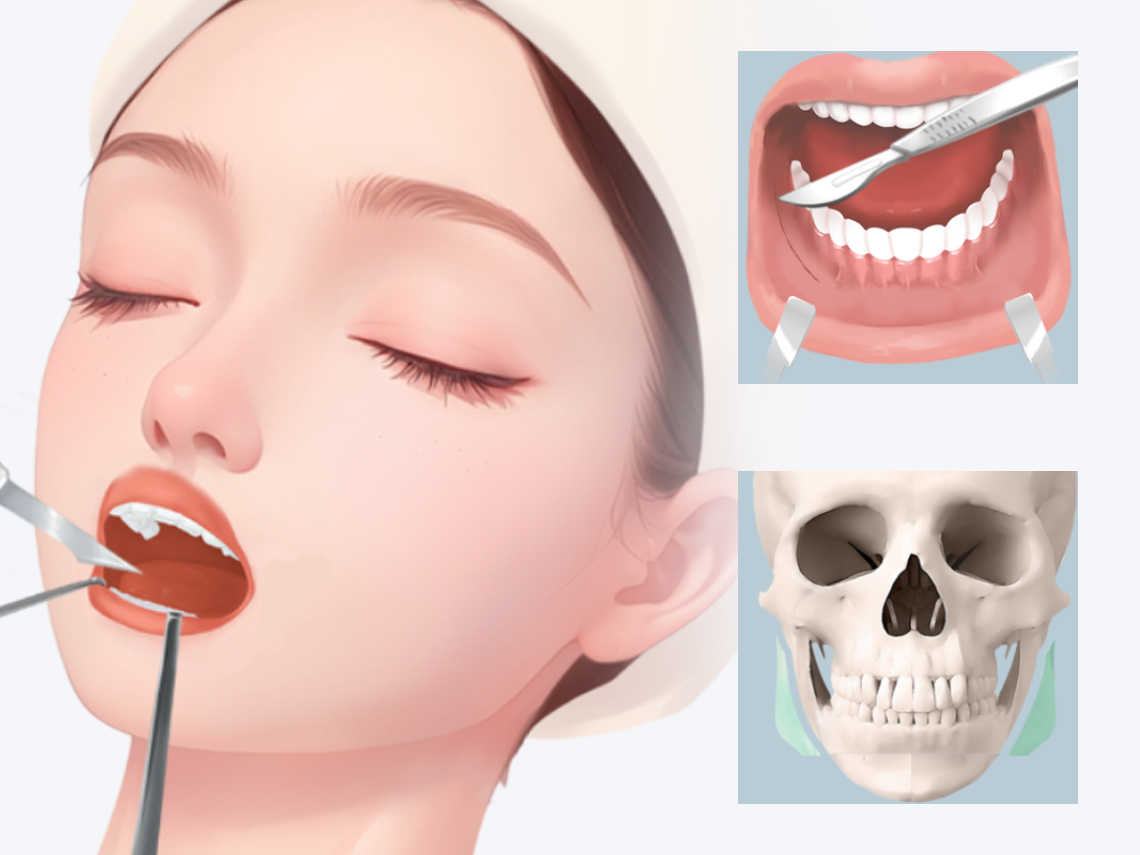 |
 |
| Procedure Overview | Blocks signal transmission between nerves and the masseter muscle | Removes the thickened portion of the masseter muscle | Grinds down part of the mandibular angle | Removes fat from the masseter area |
| Suitable Candidates | Adults with masseter muscle hypertrophy who are dissatisfied with facial contours | Adults with masseter muscle hypertrophy who are dissatisfied with facial contours | Individuals whose masseter muscle hypertrophy is caused by an overly wide mandibular angle | Individuals with significant facial fat accumulation |
| Duration of Effect | 4–6 months | 10–30 years | Long-term/permanent | 5–10 years |
| Reference Price | 3,000–10,000 RMB per session | 5,000–15,000 RMB per session | 10,000–40,000 RMB per session | 8,000–30,000 RMB per session |
| Advantages | 1. Simple procedure 2. Minimal trauma |
Precise control over amount removed |
1. Natural, smooth facial contour 2. Permanent results |
1. Minimal trauma 2. Precise targeting |
| Potential Risks | 1. Swelling likely 2. Possible nausea or headache |
1. Significant trauma 2. Risk of bleeding or infection |
1. Facial soreness or weakness 2. Risk of fracture or displacement |
1. Pigmentation 2. Post-operative need to wear compression mask for recovery 3. Skin irregularities or uneven texture |
It is recommended to pay attention to chewing habits in daily life and avoid excessive consumption of hard foods, which helps reduce the risk of masseter muscle hypertrophy.




