


How many people are needed to carry someone with a lumbar spine fracture?
Nov 25, 2025
Source: Cainiu Health

Dr. Chen Jian
Introduction
Lumbar spine fractures generally require coordinated movement by 3–4 people. The key principle is to maintain spinal alignment and stability, avoiding spinal twisting or compression during transfer, so as to prevent fracture displacement and worsening of neurological injury. If the patient experiences numbness in the lower limbs, urinary or bowel dysfunction, or impaired consciousness, immediate medical attention is recommended. A team of 3–4 people allows for precise division of labor and effective cooperation.
Lumbar spine fractures generally require coordinated transportation by 3–4 people. The key principle is to maintain spinal alignment and prevent twisting or compression of the spine during movement, avoiding further displacement of the fracture and worsening of nerve damage. If the patient experiences numbness in the lower limbs, difficulty with urination or defecation, or impaired consciousness, seek immediate medical attention.
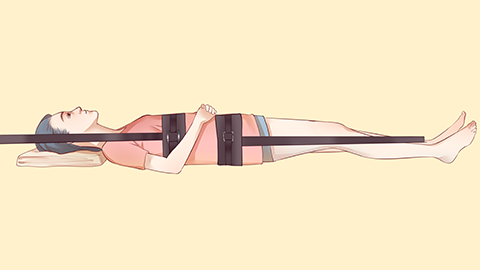
With 3–4 people involved, tasks can be precisely divided and coordinated: one person acts as the team leader and supports the patient’s head and neck, keeping the head in a neutral position; the other two or three individuals support the patient’s back, buttocks, and lower limbs respectively, ensuring the body remains horizontally aligned and moves as a single unit, with all members applying force simultaneously to prevent uneven stress on any area.
Transporting the patient with only one or two people may lead to body tilting and spinal bending, potentially causing bone fragments to shift and compress the spinal cord or nerve roots, resulting in serious complications such as paralysis of the lower limbs. Therefore, it is essential to strictly follow the standardized procedure involving 3–4-person coordinated transportation.
After moving, lay the patient flat on a hard board bed, avoid turning over or sitting up, and promptly use clothing or sandbags to stabilize both sides of the body to prevent displacement. Keep the environment quiet, closely monitor the patient’s facial appearance and limb sensation, and contact professional medical personnel as soon as possible for further transfer and treatment.





