What Traditional Chinese Medicine (TCM) Herbs Are Used to Treat Anxiety in the Elderly?
Apr 14, 2019
Source: Cainiu Health

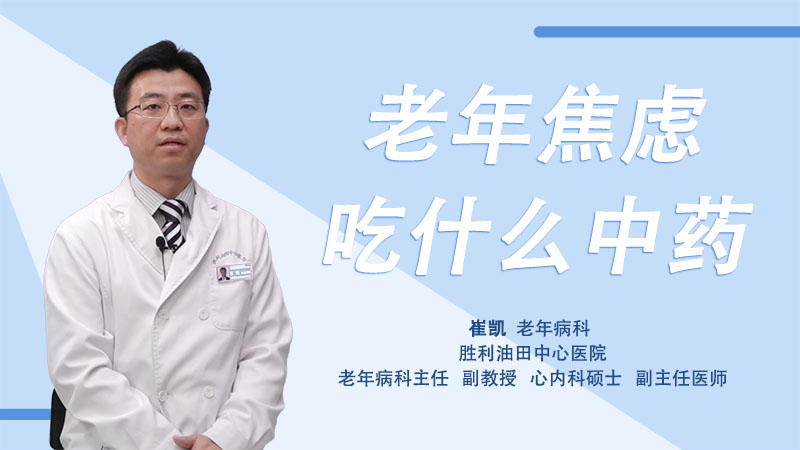
Dr. Cui Kai
Introduction
For patients with deficiency of both the heart and spleen, modified Guipi Decoction is prescribed; for those with liver qi stagnation and spleen deficiency, modified Xiaoyao Powder is used; for those with deficiency of both the heart and gallbladder, modified Guipi Decoction combined with Wen Dan Decoction is administered; for those with yin deficiency of the liver and kidney, modified Zhibai Dihuang Pills are prescribed; and for those with internal disturbance caused by phlegm-heat, modified Huanglian Wen Dan Decoction is used.
Based on its clinical manifestations, geriatric anxiety disorder falls within the scope of traditional Chinese medicine (TCM) syndromes such as “palpitations,” “depressive syndrome,” and “heart disorders.” According to TCM theory, geriatric anxiety disorder commonly arises from constitutional deficiency of qi and blood, emotional injury affecting internal organs, liver qi stagnation, impaired free flow and regulation of qi, disharmony in ascending and descending movements of qi, weakened spleen function leading to insufficient production and transformation of qi and blood, and progressive depletion of qi and blood. This ultimately results in loss of control by the heart spirit (shen), internal obstruction by phlegm and blood stasis, deficiency of gallbladder qi impairing decision-making capacity, accumulation of stagnant qi transforming into fire, and prolonged disease damaging the heart—thereby disturbing the heart spirit, causing restlessness of the shen, and resulting in loss of mental clarity and composure.
This condition primarily affects the heart, liver-gallbladder system, spleen, and kidneys—the core organ systems described in TCM. Accurate pattern differentiation is essential, followed by harmonization of the functions of these zang-fu organs to achieve therapeutic efficacy. For patients presenting with dual deficiency of heart and spleen, the herbal formula Gui Pi Tang (Restorative Spleen Decoction) is modified accordingly. For those with liver qi stagnation combined with spleen deficiency, Xiao Yao San (Free and Easy Wanderer Powder) is modified. For cases involving deficiency of both heart and gallbladder, Gui Pi Tang combined with Wen Dan Tang (Warm Gallbladder Decoction) is used with appropriate modifications. For patients with yin deficiency of liver and kidney, Zhi Bai Di Huang Wan (Anemarrhena-Phellodendron Rehmannia Pill) is modified. For those with internal disturbance caused by phlegm-heat, Huang Lian Wen Dan Tang (Coptis Warm Gallbladder Decoction) is modified. Finally, for patients exhibiting blood stasis obstruction, Tong Qiao Huo Xue Tang (Orifice-Opening and Blood-Activating Decoction) is modified.
The above outlines general treatment principles. However, individualized management requires consultation at a reputable TCM hospital, where experienced licensed TCM practitioners can conduct thorough pattern differentiation and provide personalized treatment.