


What does a liver cyst look like on CT?
Dec 01, 2025
Source: Cainiu Health

Dr. Huang Yuhong
Introduction
Liver cysts typically appear on CT imaging as low-density lesions with smooth cyst walls, no enhancement on contrast scans, uniform internal density, and a regular distribution of multiple cysts. On non-contrast CT scans, liver cysts present as round or oval low-density areas with density close to that of water, creating a clear contrast with the surrounding normal liver tissue, due to the fluid-filled nature of the cysts.
On CT imaging, liver cysts typically appear as low-density lesions with smooth walls, no enhancement on contrast scans, uniform internal density, and a characteristic distribution of multiple cysts. The specific features are as follows:
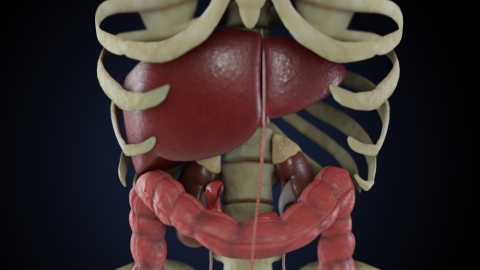
1. Low-density lesion: On non-contrast CT, liver cysts present as round or oval low-density areas with density similar to water, creating a clear contrast with surrounding normal liver tissue. This is due to the fluid-filled nature of the cyst.
2. Smooth cyst wall: The margins of the cyst appear smooth and uniform on CT, without wall thickening or nodule formation. This feature helps differentiate liver cysts from other space-occupying liver lesions.
3. No enhancement on contrast scanning: During contrast-enhanced CT, there is no enhancement within the cyst because it lacks vascular structures, preventing the contrast agent from entering.
4. Uniform internal density: The density inside the liver cyst is homogeneous, without septations or solid components. If inhomogeneous density is observed, hemorrhage, infection, or neoplastic changes should be considered.
5. Distribution pattern of multiple cysts: Multiple liver cysts appear on CT as scattered low-density lesions throughout the liver, varying in size and lacking a specific distribution pattern. However, all cysts share consistent imaging characteristics.
After detection of liver cysts, regular imaging follow-up is recommended to monitor changes in cyst size. Patients should avoid abdominal trauma, maintain a light diet, limit alcohol consumption, and seek medical attention promptly if symptoms such as persistent right upper quadrant pain or abdominal distension occur.




