How to Sterilize Baby Bottles
Aug 11, 2022
Source: Cainiu Health

Dr. Chen Zhe
Introduction
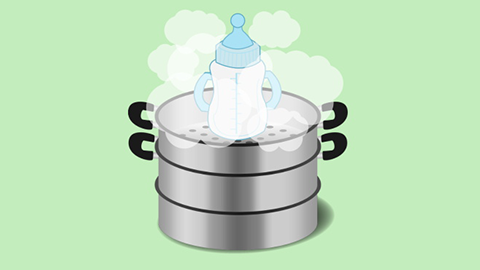
For glass baby bottles: After washing, place them in a pot filled with cold water, ensuring the water completely covers all bottles. Heat the water until it boils, then boil for 5–10 minutes. Add nipples, bottle caps, and other accessories, and continue boiling for an additional 3–5 minutes. Remove and air-dry thoroughly before use.
For plastic baby bottles: After washing, bring water to a boil, then submerge the plastic bottles, nipples, caps, and other accessories in the boiling water and boil for 3–5 minutes. Remove and air-dry thoroughly before use.
Infants fed with formula require bottle-feeding. Baby bottles must be sterilized after repeated use. How should baby bottles be sterilized?
How to Sterilize Baby Bottles
The simplest method for sterilizing baby bottles at home is boiling. For glass bottles, wash them thoroughly first, then place them in a pot filled with cold water—ensuring all bottles are fully submerged—and bring the water to a boil. Boil for 5–10 minutes, then add nipples, caps, and other accessories and continue boiling for an additional 3–5 minutes. Remove and air-dry thoroughly before use. For plastic bottles, wash them first, bring water to a rolling boil, then submerge the plastic bottles, nipples, caps, and other components and boil for 3–5 minutes. Remove and air-dry before use. It’s advisable to keep several bottles on hand and rotate their use, sterilizing them daily.
Baby bottles typically come in a 160 mL capacity, and newborns generally require the smallest nipple size. Although different brands may use identical size labels (e.g., “SS” for “super small”), this size is most suitable for newborns and young infants. As the infant grows in weight and length, larger-capacity bottles and appropriately sized nipples should be introduced.
When selecting a larger bottle, a 240 mL capacity is appropriate; correspondingly, nipples can be upgraded to sizes “S” (small) or “M” (medium). For older infants, “L” (large)-sized nipples may be required. The bottle itself may remain either 240 mL or 160 mL, depending on feeding needs. Nipple size primarily refers to the size of the flow hole, so interchangeable caps may be used accordingly. Glass bottles are considered the healthiest option. We hope this information proves helpful!