


What are the CT findings of pulmonary tuberculosis?
Dec 03, 2025
Source: Cainiu Health

Dr. Ren Yi
Introduction
In general, the CT manifestations of pulmonary tuberculosis are diverse and closely related to the type of lesion and stage of disease, mainly including patchy linear shadows, nodules and cavitation, ground-glass opacity, calcification foci, and mediastinal lymphadenopathy. The interpretation of CT findings in pulmonary tuberculosis should be made in conjunction with clinical symptoms, tuberculin skin test results, and other relevant information. Daily respiratory protection is recommended, and close contact with infected individuals should be avoided.
Generally, CT manifestations of pulmonary tuberculosis are diverse and closely related to the type of lesion and disease stage. They mainly include patchy or linear opacities, nodules and cavitation, ground-glass opacity, calcification foci, and mediastinal lymphadenopathy. A detailed analysis is as follows:
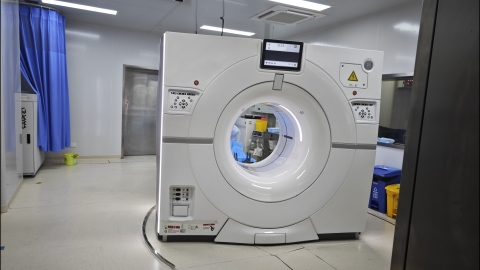
1. Patchy or linear opacities: These commonly occur in the apical-posterior segments of the upper lobes and the dorsal segments of the lower lobes and represent a typical finding in pulmonary tuberculosis. During the acute phase, they appear as high-density patchy shadows with blurred margins, within which air-containing bronchial structures may be visible. In the chronic phase, they present as well-defined linear opacities, indicating fibrotic changes.
2. Nodules and cavitation: Nodules are usually multiple, measuring 2–5 mm in diameter, with uniform density; satellite lesions may be observed around some nodules. Cavities are typically thin- or thick-walled, with relatively smooth inner walls. Fluid levels may be seen within some cavities. These findings are commonly associated with secondary pulmonary tuberculosis and represent characteristic imaging features of bacterial proliferation and parenchymal destruction.
3. Ground-glass opacity: Appears as hazy, faintly increased lung density resembling frosted glass, through which normal pulmonary vascular markings remain visible. This finding often indicates early inflammatory infiltration or active-phase disease in pulmonary tuberculosis and is a typical imaging feature of alveolar exudative lesions.
4. Calcified foci: Appear as punctate, nodular, or plaque-like high-density shadows with density similar to bone and well-defined borders. Calcification signifies healed tuberculosis, indicating stable, inactive disease. However, calcified lesions may coexist with active lesions.
5. Mediastinal lymphadenopathy: On CT, appears as round or oval soft-tissue density masses within the mediastinum exceeding 1 cm in diameter. It commonly involves unilateral or bilateral hilar and mediastinal lymph nodes. Some enlarged lymph nodes may exhibit calcification and show ring-like enhancement on contrast-enhanced scans.
The interpretation of CT findings in pulmonary tuberculosis should be combined with clinical symptoms, tuberculin skin tests, and other diagnostic evaluations. Routine respiratory protection measures should be taken, and close contact with infected individuals should be avoided. Once diagnosed, patients should follow medical guidance for standardized treatment and undergo regular CT follow-ups to assess absorption of lesions.


